LISTEN TO THE EPISODE:
APPLE PODCASTS | SPOTIFY | OVERCAST
Subspace is one of the most misunderstood parts of BDSM. If you or your partner have struggled to “get there” during a scene, you’re not alone. Most people think subspace is just a floaty, blissful feeling, but it’s much deeper than that. Today, I’m breaking down the five stages of subspace, how to reach them, and what actually helps someone get there safely and consistently.
IN THIS EPISODE
- Discover the five distinct stages of subspace, and why most people only reach stage two.
- Learn how to use rituals and routines to enter subspace more quickly and deeply.
- Explore why deep subspace depends on trust, surrender, and the right mindset.
- Learn key mistakes Doms and subs make that keep them from experiencing true subspace.
- Get essential tips for aftercare and handling sub drop to protect your emotional well-being.
What Is Subspace, Really?
Most people define subspace as “that floaty feeling during a scene,” but let’s go deeper. Subspace is actually a neurochemical state. During an intense or deeply connected BDSM scene, your brain releases a powerful mix of endorphins, adrenaline, oxytocin, and dopamine.
It’s similar to the runner’s high that athletes talk about, where the world slips away and only the present moment exists. Your rational, self-monitoring brain quiets down, leaving you open to pure sensation, connection, and presence.
But unlike runner’s high, subspace is built on a psychological foundation: trust and consent. Your body doesn’t distinguish between “real danger” and “my Dom is pushing my limits” in a safe, negotiated way. The physiological response is almost identical. That’s why subspace doesn’t just happen automatically; it takes intentional build-up and safety.
Why Most People Get Stuck at Stage Two
If you’ve ever felt disconnected, distracted, or just couldn’t “drop” into your role during a scene, it’s not a personal failing. Most people have only reached the second stage of subspace, not the deep states everyone talks about. The problem isn’t your partner, your body, or your desires. It’s about understanding the roadmap and learning how to travel it.
So, let’s break down these five stages, real signs to look for, and actual strategies to go deeper.

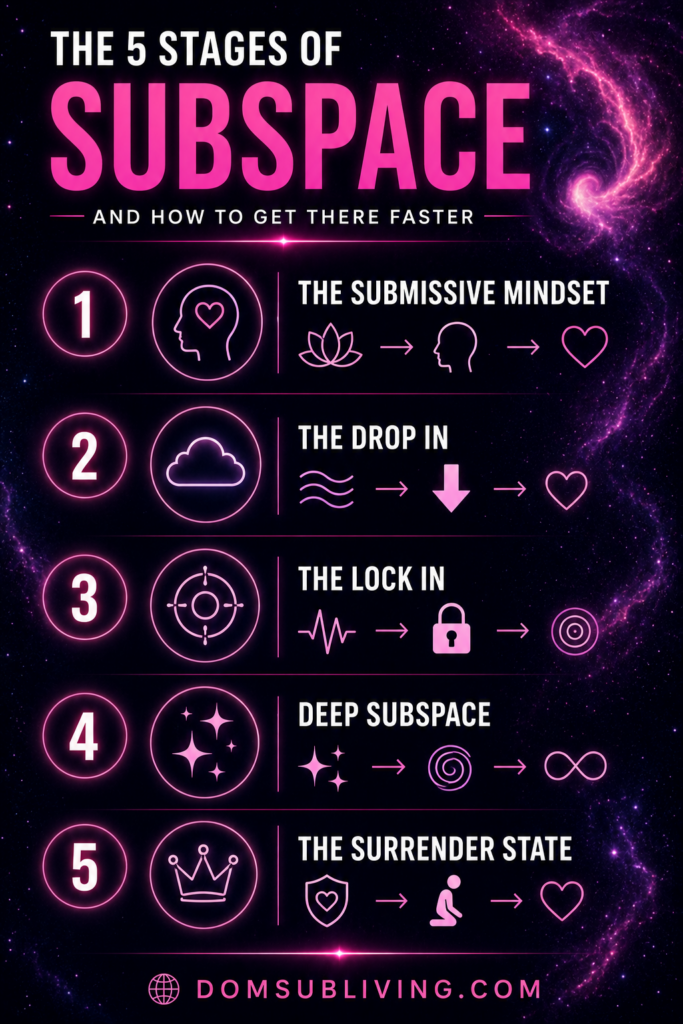
Stage 1: The Submissive Mindset
Stage One isn’t about what happens in the scene. It’s what happens before. This is when you start to orient yourself toward your Dom, feeling a sense of readiness and openness. You’re still in full control, aware, and able to make choices. But beneath the surface, you’re beginning to shift gears.
Just like an athlete warming up before a race, subs need to “warm up” before scenes. If you skip this step, or treat it like a light switch, your nervous system won’t catch up, and dropping into subspace will be almost impossible.
How to get there: Rituals are your shortcut. Whether it’s playing a specific song, using a phrase only your Dom says, changing clothes, or kneeling for your collar, these cues train your brain to shift into a submissive state almost on command. The more consistent your ritual, the faster you’ll drop into the mindset.
Stage 2: The Drop In
Now you’ll notice the first true shift. Mental chatter slows, your attention narrows, and the outside world drifts into the background. Breathing deepens, muscles relax, and you begin to respond more directly to your Dom’s voice and touch.
For Dominants, this is when your sub becomes more “tuned in” to you. Use this time to anchor the connection rather than escalate intensity. Synchronize your breathing, use grounding touch, or try holding direct eye contact. Some subs will drop deeper with a blindfold, as it removes distraction and heightens other senses. Find out which works for you.
Pro tip: The subs who drop deepest into subspace are almost never the ones “trying” the hardest. Let yourself surrender to the process and trust that your body knows what to do. Trying to force subspace keeps your brain in an analytical mode, blocking you from going deeper.
Stage 3: The Lock In
Stage Three is all about hyper-focus and flow. Your attention has narrowed almost entirely to your Dom, a physical sensation, or a single point within the scene. This is what athletes and musicians call “being in the zone,” where time stops feeling linear and instruction lands before you consciously realize it.
For Dominants: Consistency is key. Any distraction, like fumbling for a toy or checking your phone, can jolt your sub out of this state. To deepen Stage Three, use rhythm and repetition: impact play, breathwork, mantras, or repeated commands. Your sub’s brain will lock into the groove you set, allowing them to go deeper than before.
Stage 4: Deep Subspace
This is the euphoric, floaty, out-of-body state that most people mean when they talk about subspace. Endorphins flood your system. Your sense of time warps, words become harder, and your awareness of pain and self-consciousness fades. For many, this feels meditative or even spiritual. You experience total peace, safety, and connection.
But here’s the crucial part: You can’t force surrender. The harder you try to “achieve” subspace, the more active your brain remains, and the harder it is to let go. Trust, in your Dom, in the container of the scene, is the key. This is why deep subspace rarely happens in new relationships without real trust and connection.
For Dominants at this stage, you are your sub’s anchor. Reduce external stimulation, maintain your presence, and don’t escalate complexity. Hold the space, and let your sub explore this profound depth.
Stage 5: The Surrender State

Almost never talked about, Stage Five is the deepest form of subspace. The sub is completely absorbed by the experience. They aren’t directing, thinking, or even consciously choosing. They are fully held by the dynamic, trust, and their partner. Not every sub reaches this stage. It requires time, trust, the right Dom, and careful pacing through all previous stages.
Submissives describe it as, “I wasn’t gone. I was just completely inside… I wasn’t afraid of anything.” It’s an experience of ultimate vulnerability and can only be reached with a high-trust partner.
The Hidden Stage: Sub Drop and Why Aftercare Matters
After deep subspace comes sub drop: a neurochemical crash where endorphins disappear, and sadness, exhaustion, or even sickness can hit. Many people go through this alone out of shame or embarrassment, while partners may be unaware.
What helps: Real aftercare means more than a hug or a glass of water. It means staying present, offering food, checking in, and letting your sub know it’s okay not to feel okay. Dom drop is real too, so don’t neglect your own needs.
Putting It All Together
If you’re a Dom, consider what’s stopping your sub from reaching the next stage. Sometimes, it’s as simple as having a ritual, using more rhythm, or offering explicit permission to let go. If you’re a sub, remember: surrender isn’t passive, it’s the bravest kind of letting go possible.
Want to see exactly how this framework plays out? Download my free sample here.
Whether you’re a Dom or a sub, understanding these five stages will make your BDSM scenes deeper, safer, and more satisfying. Honor the journey, trust the process, and embrace your most authentic self!
Links From the Episode:
Want more? Sign up for my newsletter and get BDSM tips on the regular.